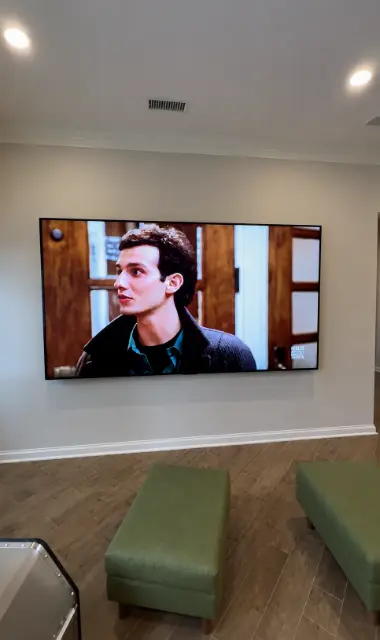
An oversized screen can fit the living-room wall but be difficult to bring through a narrow landing or elevator doorway. Before committing to the location, measure the approach: entry doors, hallway turns, stairs and the opening into the room. Keep the manufacturer’s packaged dimensions available alongside the television’s own dimensions. Packaging can make the access requirements substantially different.
For Chicago buildings with a freight-elevator reservation, loading rules or a certificate-of-insurance requirement, share the association’s instructions when requesting a quote. Access arrangements and available staging space affect the appointment plan. Do not remove packaging or attempt an awkward lift just to see whether the screen fits; discuss the route first.
Two televisions with a similar diagonal can differ in weight, rear mounting pattern, chassis depth and approved handling positions. An 85-inch or 86-inch set therefore does not automatically share a mounting solution with a 98-inch, 100-inch or 115-inch panel. ProMount evaluates the manufacturer’s specifications and the bracket’s compatibility before selecting hardware.
Large-panel handling is planned with the number of installers and access the display needs. The goal is controlled movement without pressure on the screen or unsupported twisting. Tell us if the television is already unboxed, sitting on a stand or mounted elsewhere, because removal and staging are separate parts of the work that need to be included in the scope.
Drywall is a finish, not the supporting structure. Wood studs, metal studs, concrete and masonry require different assessment and fastening methods. In a high-rise, the intended wall may also have building restrictions or limited cable access. We evaluate the structure at the proposed bracket location rather than assume that the previous television’s anchors are suitable.
Masonry condition, framing arrangement and mount requirements can all limit the installation. A wide wall does not prove adequate support, and an advertised screen-size range on a bracket does not establish compatibility. If the structure or equipment is unsuitable, the plan may require a different mount, reinforcement or a different wall before the TV can be installed.
An extended full-motion arm changes how a television loads its support. A large display also sweeps a considerable area as it turns. Mount selection therefore includes the TV’s weight and mounting pattern, the intended extension, the bracket’s instructions and the wall assembly—not simply whether the product listing says “100-inch.”
We check clearance from side walls, trim, cabinetry and furniture before recommending movement. A fixed or tilting bracket may suit a room better when access or structure limits an articulating arm. Tell us which seats need a clear view and whether you need to reach connections behind the screen; those are useful reasons to consider movement without assuming it is always necessary.
A large panel occupies more vertical space than the TV it replaces. Reusing the old bracket height can put the new picture much higher than expected or leave too little space for a console and soundbar. We consider the seated view, furniture, panel dimensions and the available wall before confirming placement.
Above a fireplace, the mantel and fireplace manufacturer’s clearances add another set of constraints. A bigger panel is not a reason to ignore them. If the viewing position or heat exposure is inappropriate, another location may be preferable. Final alignment also considers the room’s visual reference lines so the television is level rather than simply following a sloped mantel or ceiling.
Plan cable destinations before the panel covers the wall. HDMI sources, network connections, an existing outlet and a soundbar can each need access beyond the bracket footprint. ProMount offers cable management and concealment where the wall, cable rating and equipment permit it; a surface channel is an alternative when an internal route is unavailable.
Power cords and extension cords must not be buried in the wall. Any required electrical work must use an appropriate solution and qualified electrical help where necessary. Soundbar position should preserve the TV’s movement, controls and clearances. Include the soundbar model and intended sources with your request so those parts are not left as an afterthought.
List the model, diagonal, mount model, wall finish and room location. Add photos showing the full wall, nearby furniture and the access route rather than a tightly cropped picture of the old bracket. If the wall construction is unknown, say so; a guess can hide the very detail that changes the hardware plan.
ProMount serves Chicago and nearby communities already included in our service area, including Skokie, Oak Brook and Elmhurst. This page focuses on city-specific access and placement planning; the main oversized-TV service guide covers equipment considerations across Chicagoland. Your appointment scope and availability are confirmed from the actual information you provide.